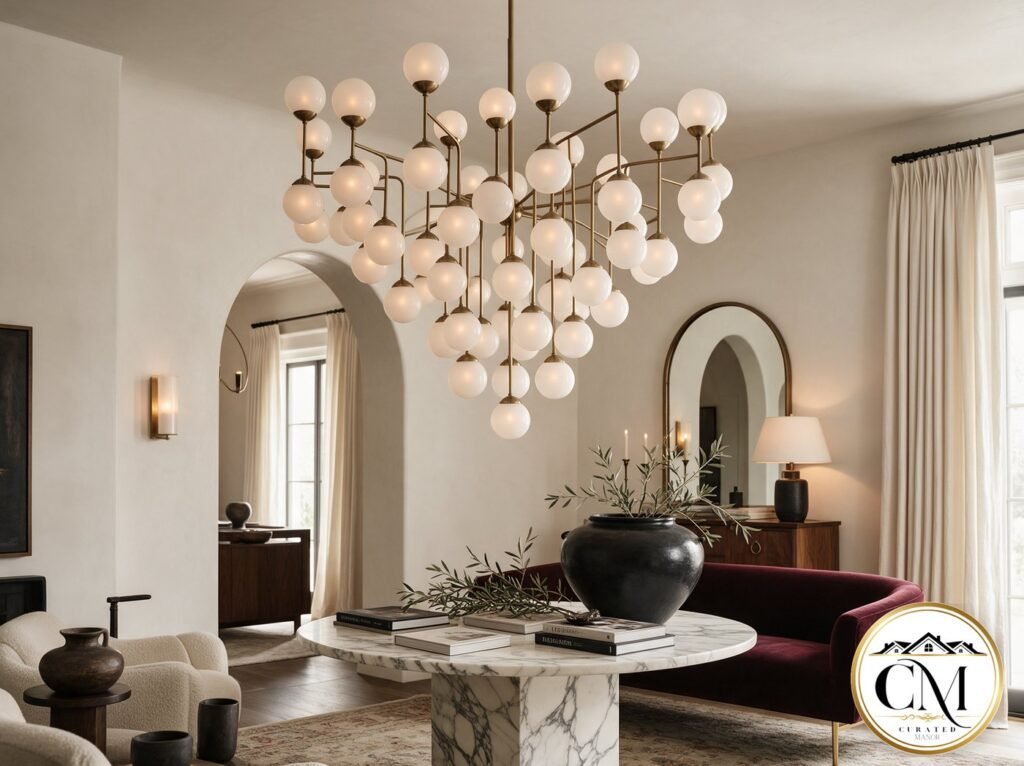
Restraint has had a long run. Beige sofa, beige rug, beige wall, one olive branch — and a lot of rooms that photograph beautifully and feel like nothing at all to stand in.
This is the other lane. Velvet, gold legs, arches, a light fixture that isn’t apologising. Done carelessly it goes gaudy fast, so here’s how to get the drama without the costume.
Curated Manor may earn a commission from qualifying purchases at no additional cost to you. As an Amazon Associate, I earn from qualifying purchases.
Pick one thing to be loud
Every room that pulls this off has a hierarchy. One piece is the showpiece and everything else agrees to support it.
Usually that’s the lighting, because a fixture sits at eye level in an empty part of the room where nothing competes with it. Sometimes it’s a sofa in a colour you’d call brave. Occasionally it’s a mirror tall enough to be furniture.
What it can’t be is all three. Two showpieces in one room read as indecision; three read as a showroom.

Modern glamour, not period glamour
The difference between a chandelier that looks expensive and one that looks like a rental hall is almost always the shape.
Crystal tiers, scrolled arms and candle sleeves read as period costume in a house that isn’t period. Slim brass arms holding frosted globes read as sculpture. Same drama, no fancy dress.
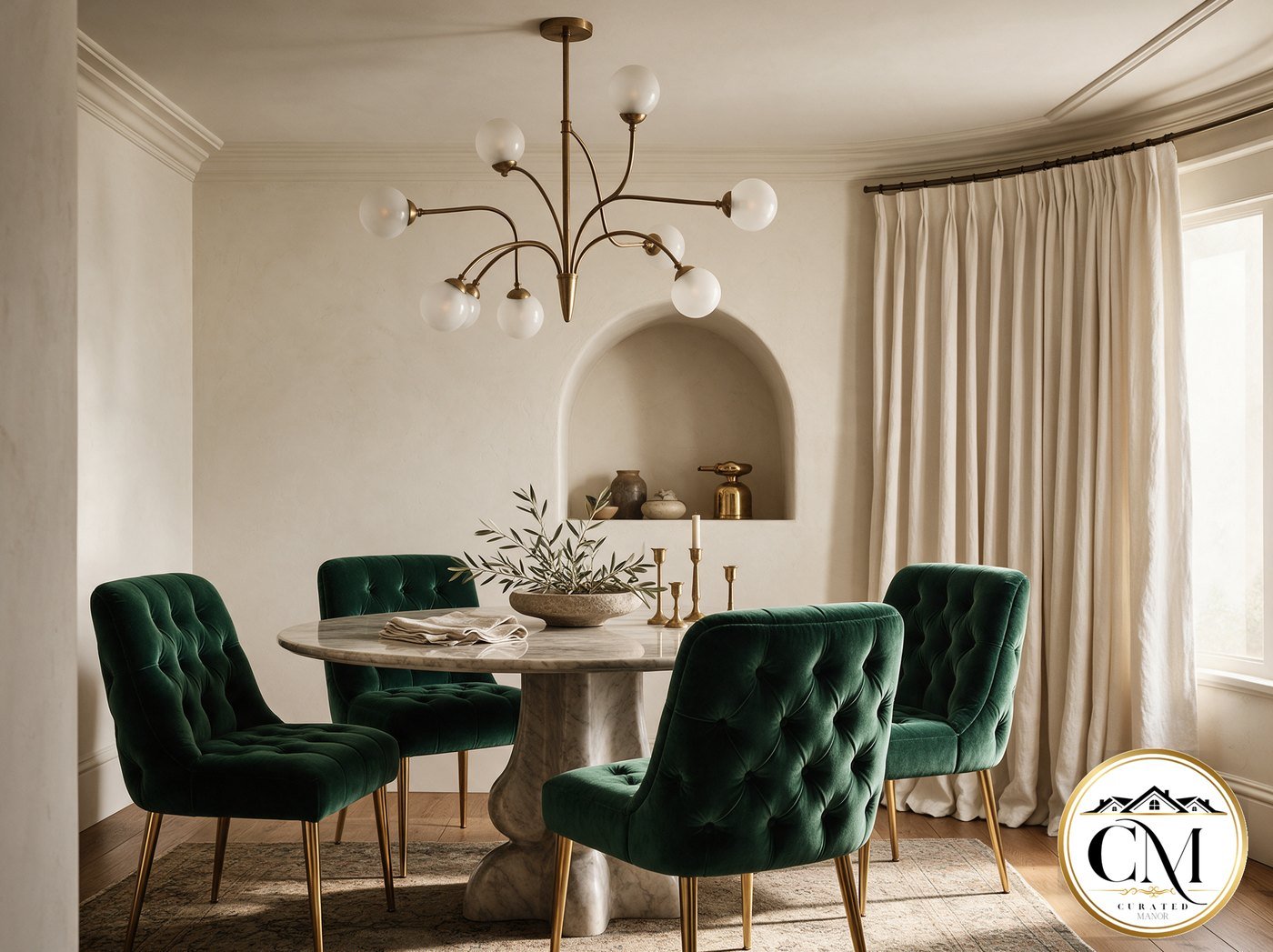
Look for a fixture with a clear geometry you could describe in one sentence, and hang it low enough to matter — over a table, roughly 30 to 34 inches above the surface.
Pricing and availability change often — check current listings before you buy.
Velvet is a lighting trick
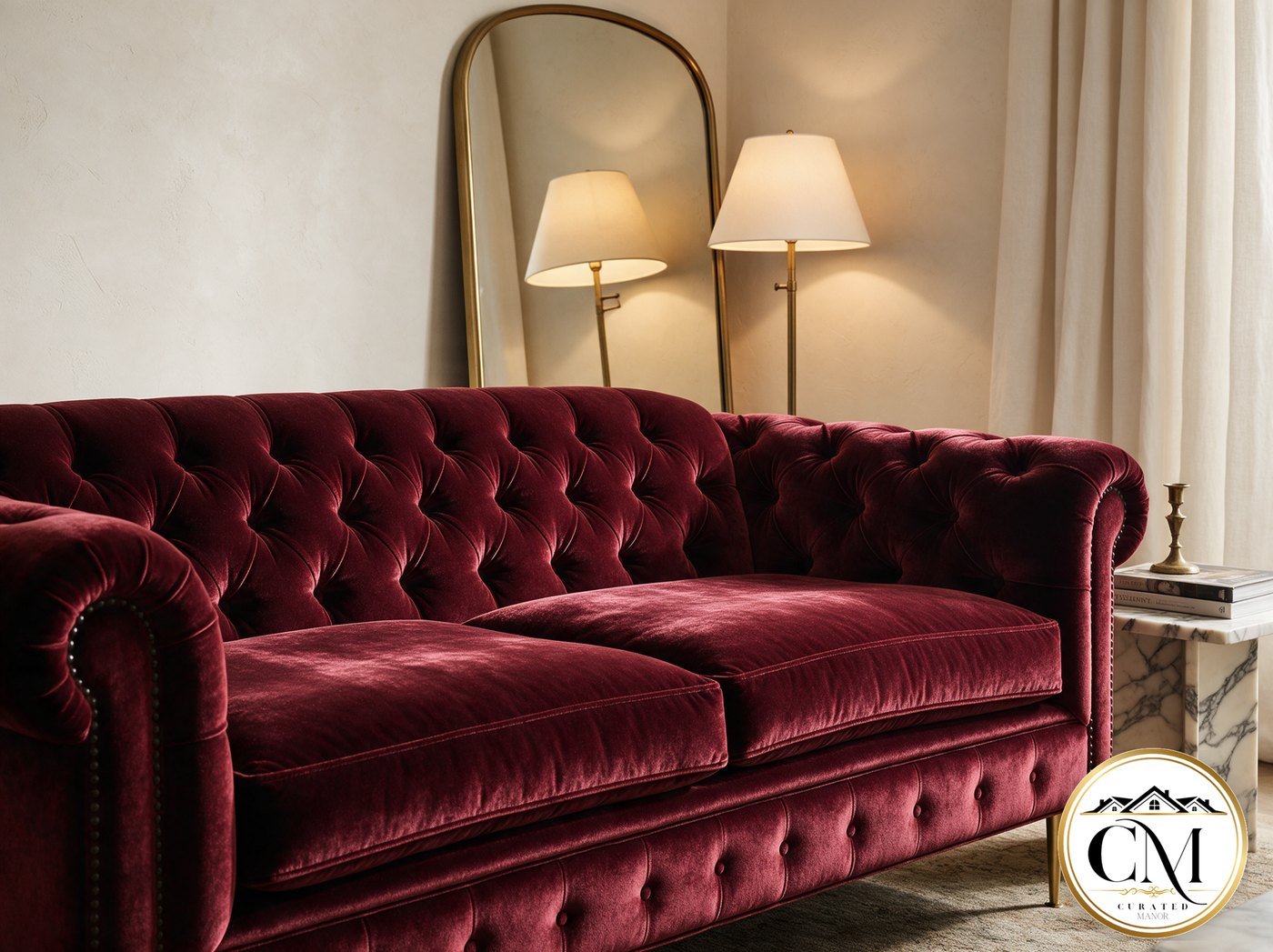
Velvet isn’t just a texture, it’s a way of holding light. The pile catches it at the top of every curve and drops it in the folds, so a velvet piece has depth at every hour of the day. That’s why a burgundy velvet sofa looks rich and the same shape in flat cotton looks like a couch.
It rewards saturated colour too. Burgundy, emerald, ink, tobacco — colours that would feel heavy in a matte fabric look like jewels in velvet.
Buy it in the piece you sit on and look at, not in the throw pillows alone. Pillows are where velvet goes to be forgotten.
Gold legs work when the metal repeats
A single gold-legged chair in a room of black metal looks like it wandered in from another house. The leg isn’t the problem — the loneliness is.
Pick your metal and let it appear at least three times: the chair legs, a lamp base, a mirror frame. Once brass shows up in three places it stops being a finish on one object and becomes the room’s metal.
Warm brass sits better with velvet and wood than bright chrome-gold, which tends to look plated under lamplight.
Arches soften a boxy room
Most rooms are a stack of rectangles — door, window, sofa, rug, television. A curve is the cheapest way to break that up.
An arched mirror is the easiest entry point because it’s a curve you can lean against a wall in an afternoon. A round table, a barrel chair or a curved sofa back does the same work at furniture scale.
Repeat the curve once if you can. A single arch reads as an object; two read as intention.
What to skip
Skip anything with visible rhinestones or crystal-effect plastic. It photographs badly and looks worse in person.
Skip a full matching set — velvet sofa, velvet loveseat, velvet ottoman in one shade. Velvet is strong enough that repeating it wholesale flattens the room.
And skip glamour in every room of the house. This look lands hardest when there’s somewhere quieter next door to compare it to.
Where to take it next
Choose your one loud piece. Put velvet on something you sit on. Repeat the metal three times, add one curve, then leave the rest of the room calm enough that the showpiece has somewhere to breathe.
That’s the whole formula, and it works at nearly any budget, because drama comes from shape and material — not from the price tag.
Next: read Quiet Luxury Is Growing Up for the warmer, more collected version of this, or browse the Fancy Finds edit in the shop.