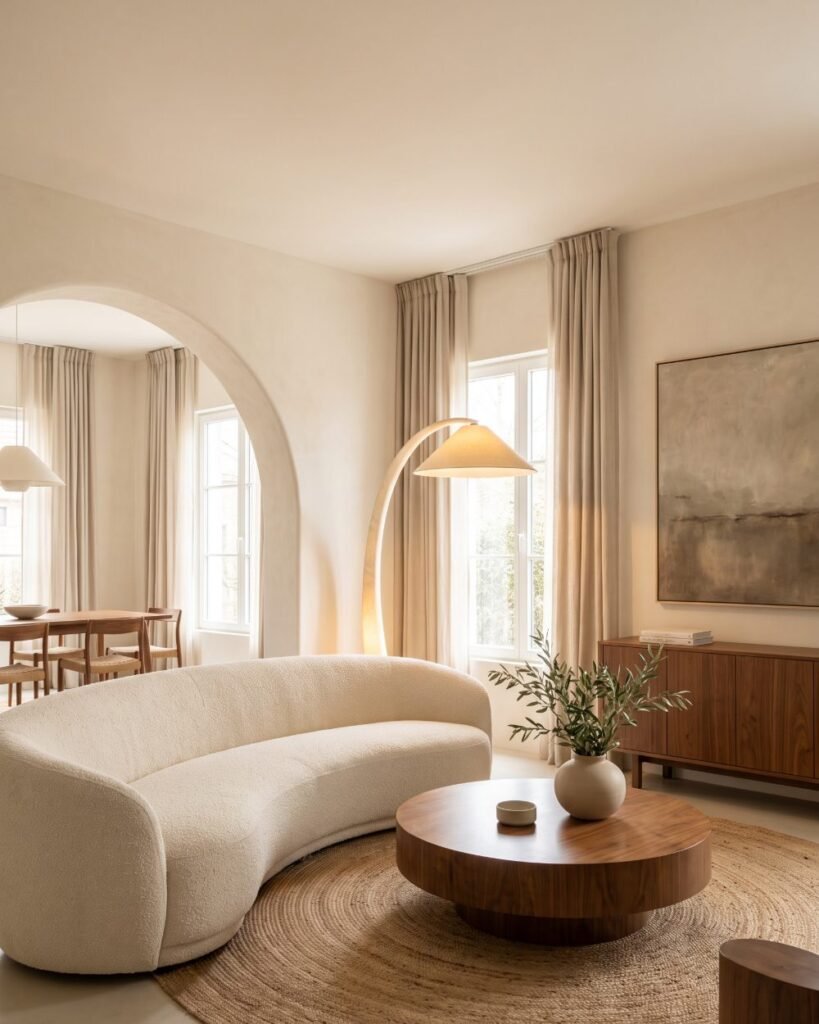
You can usually tell when a room has been softened on purpose and when it has just collected a lot of round things. The difference is whether each curve is doing a job.
Arches, rounded furniture and soft geometry hold up over time when you treat them as part of the room’s structure rather than as decoration dropped on top. Used that way they make a space feel calmer and easier to move through. Used carelessly they blur every edge until nothing reads clearly.
Why rounded forms last
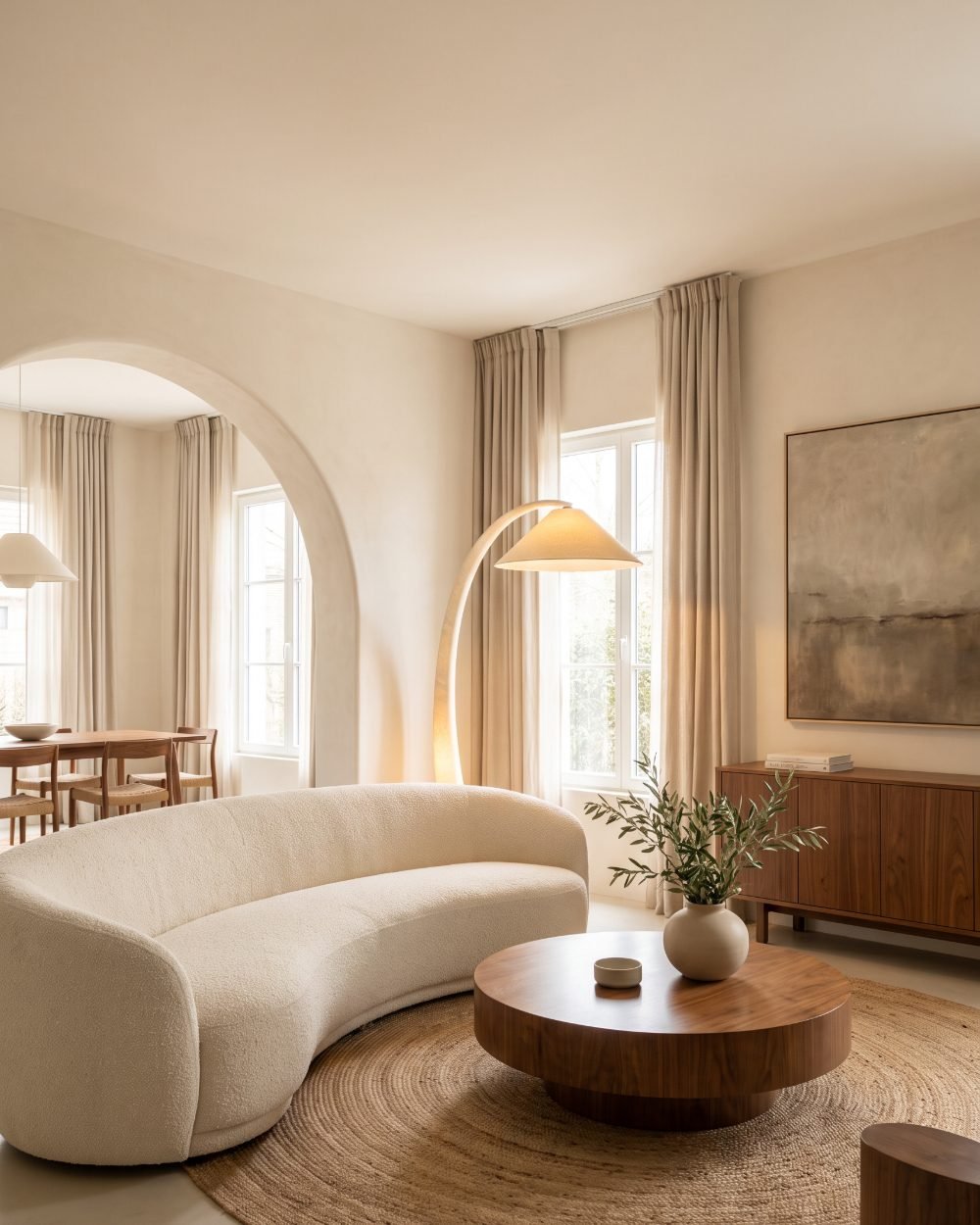
Curves feel permanent when they improve how you actually use a room. A round dining table lets you move around it in a tight space. A curved sofa creates a conversation area without dropping a hard visual barrier across an open plan. An arched opening gives two zones their own identity while keeping sightlines open.
That is the test worth applying before you buy anything. Ask what the curve is for: guiding movement, supporting gathering, softening a focal point, or giving relief against a mostly straight shell. If it isn’t doing one of those, it’s ornament.
Start with the architecture
Architectural curves set the room’s shape before a single piece of furniture arrives. An arched doorway works best replacing an ordinary opening between spaces that already want separating, like a hall and a living room.
Match the profile to the building. A simple semicircle suits most homes; a shallow segmental arch tends to sit better in contemporary rooms. Avoid putting several different arch shapes in one sightline, which is the fastest way to make a house feel like a showroom.
Curved walls earn their place when they solve an awkward bit of circulation, such as a tight entry or a passage around a stair. A gentle radius is usually more useful than a dramatic sweep because it keeps floor area and makes furniture placement simpler.
Choose rounded furniture that improves the layout
Use curved furniture where it clears circulation or softens a room dominated by rectangles. Keep each piece proportional to the floor area you actually have.
Curated Manor may earn a commission from qualifying purchases at no additional cost to you. As an Amazon Associate, I earn from qualifying purchases.
In a smaller room, one rounded chair does more than a full curved sectional and costs a great deal less. A swivel barrel chair like this ivory bouclé barrel chair adds a soft silhouette and a nubby texture without eating the floor plan.
Round coffee tables work well when people need to move around the middle of the room, especially near doorways or with small children about. A round wood coffee table removes the shin-height corners entirely. Where your sofa is longer, an oval coffee table gives you more surface while keeping circulation soft on both sides.
Leave roughly 16 to 18 inches between the table and the sofa for legroom, and keep about 30 to 36 inches of clear passage along the main walking routes. For a smaller sculptural note, a round pedestal side table adds shape with far less visual mass than an upholstered piece.
Availability changes often, so check before you buy.
One caution worth repeating: don’t buy the sofa, chairs and tables as a matched rounded set. Repeat shape, colour or material, rarely all three.
Layer softer details through lighting and decor
You can introduce curves without replacing anything large. Lighting and mirrors are the cheapest route in.
A round mirror breaks up the straight edges of cabinets, tile grids and rectangular art. Hang a round wood-framed mirror above a console or mantel where it has a hard horizontal line to soften. Where you want vertical emphasis instead, an arched full-length mirror echoes an arched doorway or window without needing any building work. There’s more on sizing these in our guide to full-length floor mirrors.
For lighting, choose globe shades, curved arms and gently irregular glass over fussy silhouettes. An arc floor lamp reaches light over a reading chair or dining corner without a ceiling fixture, which makes it useful in rentals. A brass globe pendant does similar work overhead. Keep the base of any arc lamp outside the main walking path.
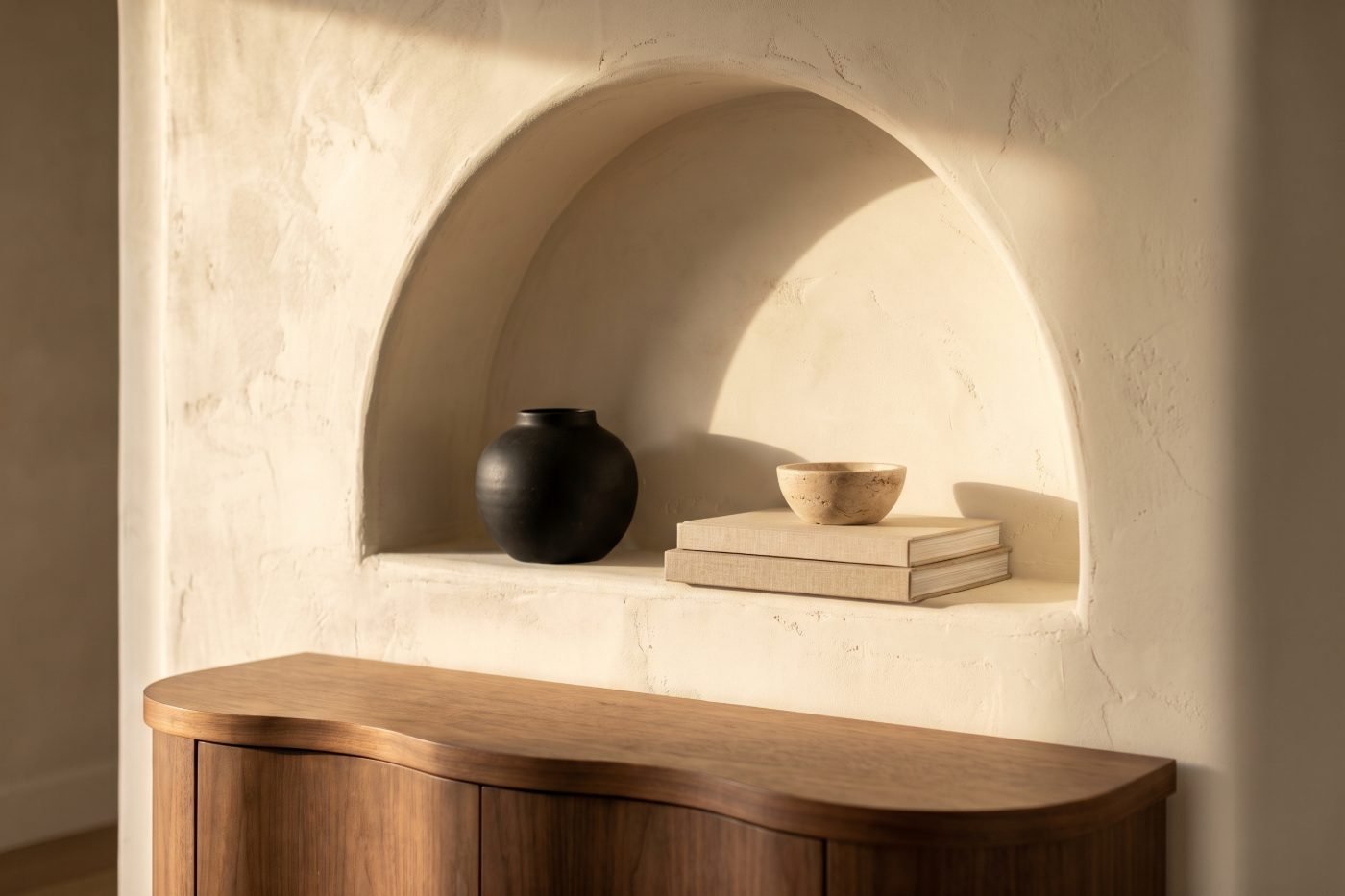
Then keep the small stuff restrained. A large ceramic vase with a rounded profile, a low bowl, a softly shaped lamp base — group two or three at different heights rather than filling a shelf. Matte finishes suit this better than gloss because they reduce visual sharpness.
Use curves room by room
In the living room, start with the seating plan. A curved sofa wants a focal point to face and clear space around it; pushed tight to a wall it just loses floor area. A round jute rug can reinforce a compact grouping, though a rectangular rug is usually the better call when you need to tie curved seating into a linear room. Our guide on what size rug your living room needs covers the sizing.
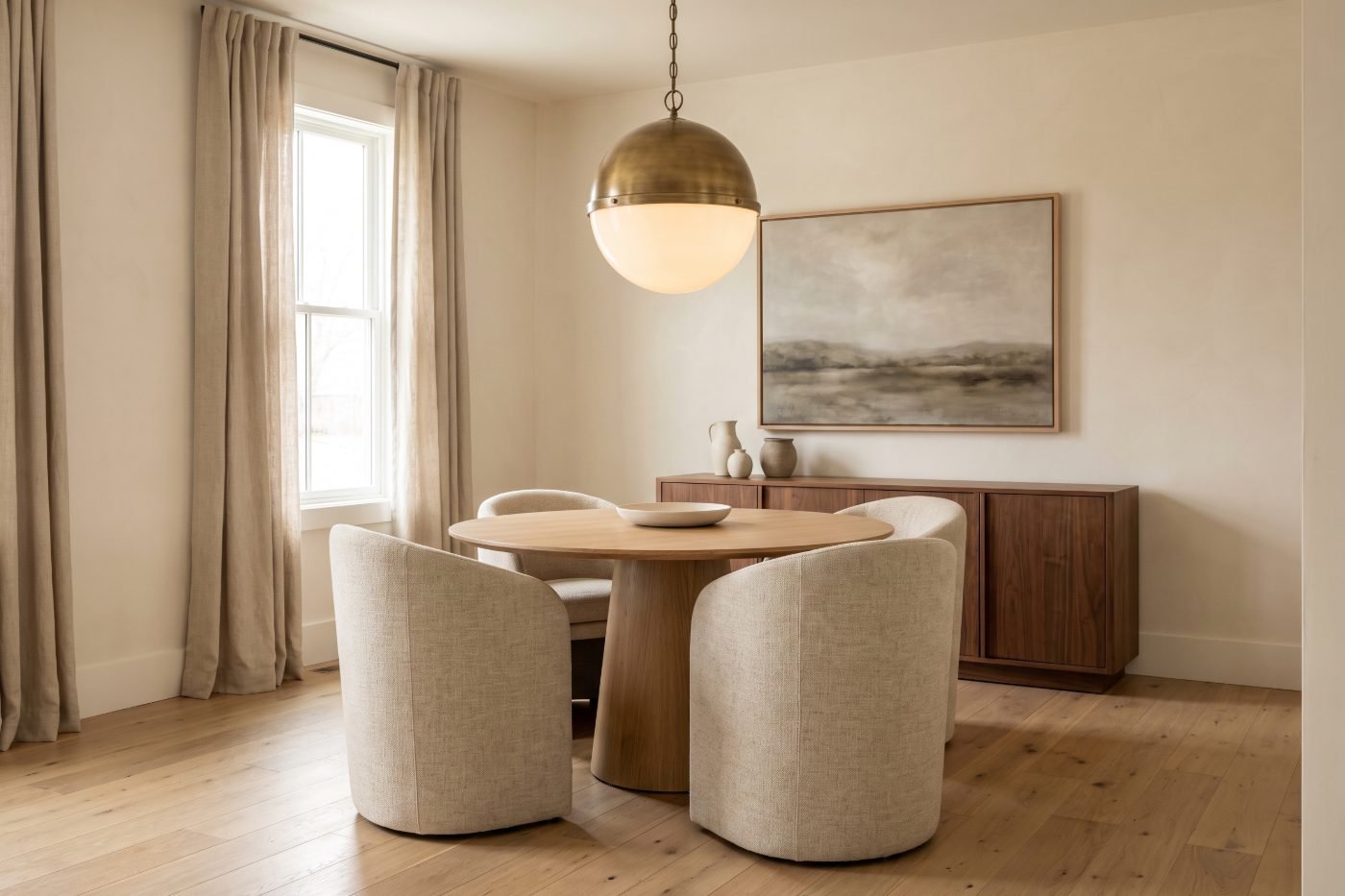
In dining areas, a round table suits compact rooms because it removes sharp corners and lets people move around it. Choose oval when you need more seats but still want a softer outline than a rectangle.
In bedrooms, let the bed stay the anchor and add softness through a curved headboard or a rounded bedside table, with straight-lined wardrobes holding the room steady. In entryways and small spaces, choose slim rounded pieces over bulky sculptural ones — a round bouclé storage ottoman works as a seat, a footrest and hidden storage in about two feet of floor.
Floor-length linen curtains hung close to the ceiling help too. They add a soft vertical fall that keeps a room with hard architecture from feeling rigid.
The mistakes that make curves look trendy
Three things separate a considered room from a themed one.
Too many statement shapes in one view. A curved sofa, arched mirror, scalloped cabinet, round table and globe pendant all visible at once stop reading as calm and start reading as a collection of trends. Pick one primary curved feature per major sightline and let the rest be quiet.
Wrong scale. Rounded furniture usually needs more floor area than its rectangular equivalent. A curved sectional projects into walkways, and a large round dining table needs clear space around its entire perimeter. Measure the circulation before you buy, not after.
Permanent curves chosen on a whim. Treat built work differently from furniture. An arch, a curved wall or a radius island involves construction, so keep those simple and well-proportioned and save the more distinctive shapes for chairs, lighting and accessories you can change your mind about.
Curves work because they contrast with something. Keep the cabinetry straight, the shelving linear, the rug edges clean — and the soft shapes will read as deliberate for a lot longer than the trend cycle that made you notice them.
Want it laid out as a complete, shoppable room? Start with our Room Recipes, or read up on the layered lighting formula to get the lighting layer right.